Metal says: follow and change; what follows and changes becomes the pungent taste.
You already know.
You haven't said it out loud, but you know. A relationship died months ago, and you're still performing it. An identity no longer fits, and you're still wearing it. A hope that long since collapsed, and you pretend not to notice.
You don't say it, because saying it makes it real. Because saying it means you'd have to do something. Because saying it means you can no longer call it “still figuring it out.”
Not saying it costs more: you start doubting your own judgment. You maintain two realities at once—the one you live in, and the one you pretend is still true.
Two characters name this sequence.
Cong. Ge.
01
Cong Comes First
The Hong Fan says: Metal says follow and change; what follows and changes becomes the pungent taste.
That's it. No forging, no fire, no smiths, no swords. Only: metal is that which follows and changes.
Scholarship has no consensus. Some read it as an intrinsic capacity; others, as external compliance. Whether the two characters imply a sequence is not stated in the text itself.
Baziritual chooses to read that sequence seriously: Cong comes before Ge.
You must first cong—acknowledge what you can no longer deny—before ge can happen. Acknowledgment is not resignation. It is stopping the fight.
What have you been fighting? A relationship that should have ended. A path that no longer leads anywhere. A version of yourself you no longer are. That fight is not strength. It's what keeps change from arriving.
Is admitting something is over a surrender? Or is it the first active move you can make?
02
Ge Has a Price
The old form cannot be preserved and transformed at the same time.
Hong Fan gives us no forge, no smith, no sword—only two characters. But metal's own material behavior offers an image worth borrowing, on the understanding that it is ours, not the text's:
A sword is melted down and cast into a plough. The sword is gone. You cannot keep the intact sword and have the plough made from the same metal. The two forms are mutually exclusive.
That is the price of ge. It is not adding something to the old. It is the old genuinely ceasing to exist.
Centuries later, the Baihu Tong—a Han-dynasty record of court debate—says: “Righteousness is decisive cutting off.” Not drawing a boundary. Not gently letting go. Cutting off. Ending.
What must stop for change to be real? A relationship that cannot be repaired. A job that cannot be fixed into something you want. A self you have already, in every real way, stopped being.
03
We Want Change Without Loss
The culture around you promises: growth, healing, integration, becoming a better version of yourself.
Beneath it lies a quiet promise: you can become new while keeping everything you were before.
Metal challenges that directly. If nothing is lost, what actually changed?
Every ending gets repackaged as a beginning. Pain becomes wisdom. This is comforting—but it also makes it harder to recognize an ending as an ending. You reach for the gain before you've felt the loss. You never really say goodbye to anything.
Ge doesn't soften loss. It doesn't promise that what you lost will return in better form. It only says: the form has changed, and the old one is gone.
What if real change is an irreversible subtraction?
04
Not Yet Named
The hardest part isn't the ending.
It's the gap after the ending, before a new form takes shape. The old identity no longer organizes your life. The new one has no name yet. No answer. No position.
People cling to obsolete forms not because they're still good, but because they have a name. The new form has none. You drift. You wait. It looks like failure.
But what if that emptiness is not failure?
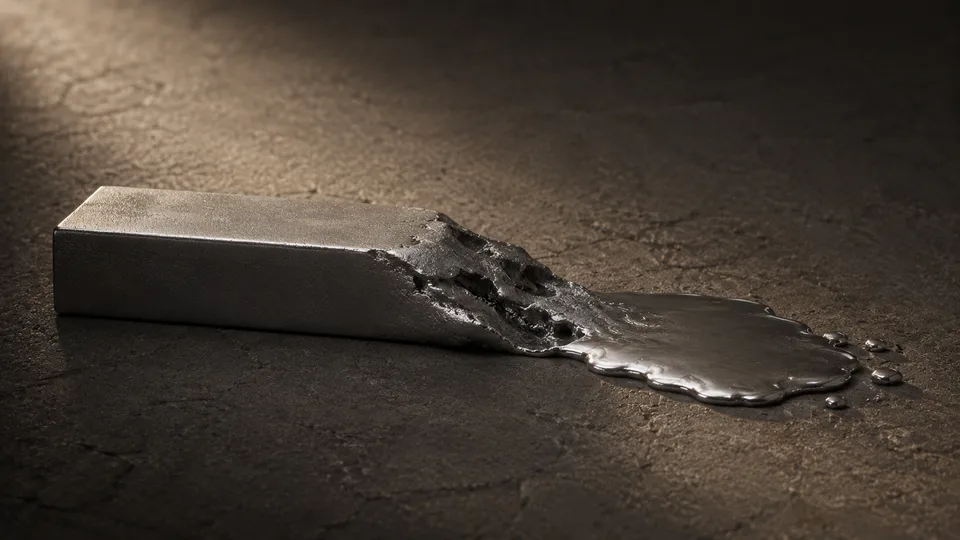
The melted sword is not yet a plough. It is liquid metal—no shape, no name, no purpose. If the sword could feel, that moment would feel like annihilation: it no longer recognizes itself, and it cannot see what it will become.
The old form is gone. The new form has no name. In that gap—what are you?
Metal says follow and change; what follows and changes becomes the pungent taste.
Two characters, read in an order that, once chosen, cannot be reversed:
Cong comes first: acknowledgment.
Ge follows: the old shape is no longer preserved.
What comes after that—the Hong Fan does not tell you. And we need not rush to answer it on its behalf.
What have you been calling “still figuring it out” that has, honestly, already ended?
You know the answer.
Cong means: stop pretending you don't.
Continue the Practice
If you'd like to understand how Metal functions within the full Five Elements system—and how it interacts with your own life structure—try Baziritual's free Element Profile.
It won't tell you “whether you're a Metal person.” It will show you, within your life structure, which movement patterns are more prominent and what relationships are at play.
Not a label. A starting point for observation.
Explore Your Element Profile →