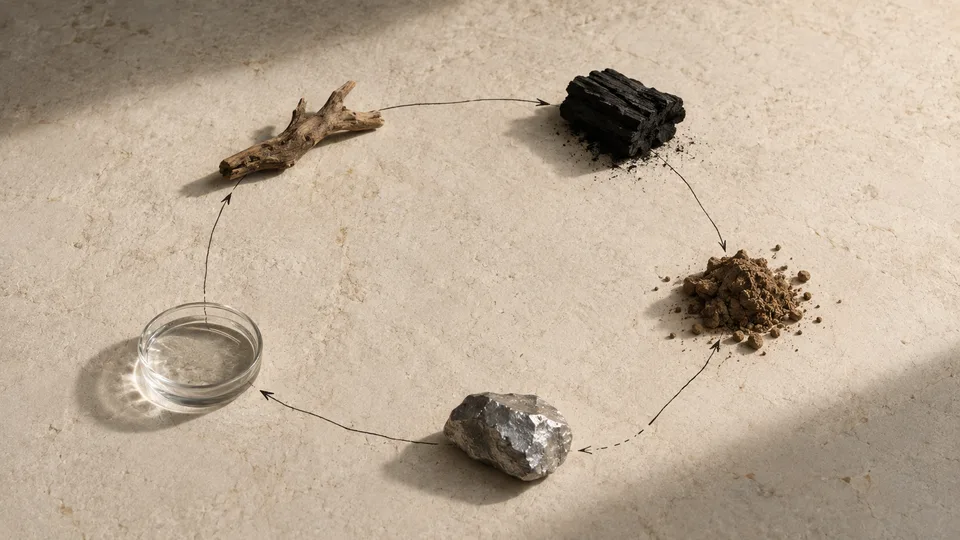
If you’ve ever seen a Five Elements diagram—Wood generates Fire, Fire generates Earth, Earth generates Metal, Metal generates Water, Water generates Wood, five characters arranged in a circle—you might assume this is something ancient. Chinese cosmological thought is often described this way: five elements mutually generating, cycling without end. It sounds complete, ancient, “just how it is.”
But “just how it is” is precisely the assumption worth examining.
01
This Circle Wasn’t There from the Start
The circle we know today—Wood→Fire→Earth→Metal→Water→Wood—doesn’t appear in the earliest text that systematically lists the Five Phases.
The Hong Fan chapter of the Book of Documents is the earliest extant text to list the Five Phases systematically. How does it list them? “First: water. Second: fire. Third: wood. Fourth: metal. Fifth: earth.” The order is Water, Fire, Wood, Metal, Earth—different from today’s circle. Each phase is paired with a description: water is soaking-and-descending; fire is blazing-and-ascending; wood is bent-and-straight; metal is yielding-and-changing; earth permits sowing-and-reaping. The five descriptions are parallel, each independent, none generating another.
More importantly: throughout the entire Hong Fan passage, no verb connects one phase to another—no generating, no overcoming, no controlling. It’s just a list.
A list and a cycle are two different things.
Later, thinkers began using these five categories to organize seasons, directions, political orders, and the relationships among them. Wood was matched to spring, Fire to summer, Metal to autumn, Water to winter—a real order, tied to the turning of the year. But being lined up by season didn’t yet mean one produced the next. Spring coming before summer is not the same claim as Wood generating Fire. An order is not a cause.
The “generating cycle” was one of the later developments built on top of this order. The list itself didn’t change; how people used it did.
02
When “Generate” First Appeared
So when did the term “mutually generating” (xiangsheng) actually appear?
Among the early texts that can be dated with reasonable confidence, the Huainanzi’s “Tianwen Xun” chapter (c. 139 BCE) gives one of the earliest explicit and complete generating sequences: “Water generates Wood, Wood generates Fire, Fire generates Earth, Earth generates Metal, Metal generates Water.”
This is the earliest place we can confidently see all five relationships stated together, explicitly, in a single sentence.
A few details worth noting: it starts with Water, not Wood. This suggests that, at this point, no one had fixed Wood as the “starting point” of the sequence—which phase came first didn’t seem rigid. Also, the text doesn’t say “this is a cycle” or “it turns around and returns.” It simply lists five statements, which happen to end with the one that brings things back to where they started.
Sequence existed. Relationship existed. But the idea of “a circle”—that closed, revolving sense of things—hadn’t yet appeared in the written record.
03
Are the Five “Generates” Really the Same Kind of Thing?
This is the place worth pausing over.
Today we call Wood generates Fire, Fire generates Earth, Earth generates Metal, Metal generates Water, Water generates Wood all sheng, as if the five arrows describe the same thing. But when you actually look at what each one says, they differ considerably.
Wood generates Fire—the traditional explanation: wood’s nature is warm, fire lies latent within it, and drilling draws it out. This is “release”: fire was already inside the wood; you bring it out.
Fire generates Earth—fire burns wood to ash, and ash is earth. This is “residue”: after fire burns, what’s left becomes earth.
Earth generates Metal—the traditional chain runs like this: earth piles up into mountains, and mountains, it’s assumed, give rise to rock, and metal is drawn from that rock. Call it “extraction,” but a looser one than it first sounds—there’s a real inferential leap in “mountains necessarily produce rock” that the other links don’t need.
Metal generates Water—this one is the most problematic. Later explanations invoke both condensation on cold metal surfaces and metal melting into liquid, sometimes adding cosmological concepts like “lesser yin qi” to bridge them. Compared to the others, it is noticeably harder to explain in terms of a single intuitive physical relationship.
Water generates Wood—water nourishes trees, and trees grow. This is “nourishment.”
Five sheng, five rather different logics. One is release, one is residue, one is a stretched extraction, one is a strained hybrid, one is nourishment.
None of this proves that Metal generates Water was invented just to complete the system. But it does at least remind us: don’t assume the five sheng were originally derived from five perfectly symmetrical natural phenomena.
If you’ve been translating sheng as “produce” or “generate,” you might think these five arrows describe the same kind of thing—A produces B. But when you look at what each one actually describes, “produce” turns out to be too broad a word, broad enough to cover over the real differences among them.
Metal generates Water, especially. Pause and ask: in what sense does metal “generate” water? The explanations the tradition itself offers are the most convoluted of the five. This arrow isn’t just a curiosity—it’s the one that exposes the problem most clearly. At the very least, it shows: we cannot treat the entire generating system as five parallel formulas for material production.
04
So What Is This Circle For?
At this point you might ask: if this circle wasn’t there from the beginning, and if the five “generates” don’t describe one unified mechanism, then what’s the point of this diagram?
Maybe we’ve been asking the wrong question.
We’ve been asking: “Can A truly produce B?”—Can wood truly generate fire? Can fire truly generate earth? Can metal truly generate water?
Maybe the right question is different: “What kind of relationship is this arrow trying to describe?”
Fire needs wood to burn. Fire leaves ash behind. Metal comes from within the earth. Water lets a tree grow. Four different relationships, each with its own intuitive grounding—but not the same causal mechanism.
The value of the “generating cycle” framework may not lie in revealing a unified natural law, but in bringing five different relationships into a single diagram you can look at all at once. It forces you to think: between this and that—what actually goes on?
The previous six articles each examined what Water is, what Wood is, what Fire is. This one asks something else: what happens between them?
Looking at this circle today, we can read it as a relational frame: don’t just ask what a thing is in itself—ask what it depends on, and what it, in turn, makes possible for what comes next. As for what each arrow is actually describing—that’s a question worth asking one arrow at a time. And the Metal→Water case is precisely the one that reminds you: don’t assume they’re all the same.
Continue the Practice
If you’d like to see how these relationships play out in a real life structure rather than a diagram, try Baziritual’s free Element Profile.
It won’t tell you which element “generates” which in your chart as a fixed rule. It will show you which relationships are actually active in your own structure.
Not a formula. A starting point for observation.
Explore Your Element Profile →